
Project overview
Fixed monetary rules.
Broader monetary use.
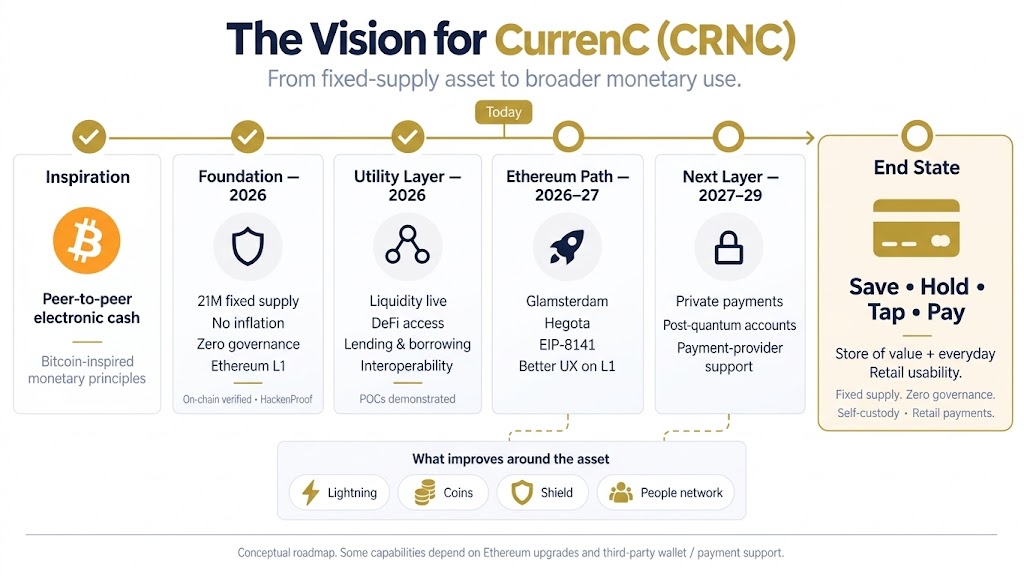
CurrenC (pronounced CUR-en-see; symbol: CRNC) is Bitcoin-inspired hard money built on Ethereum. Fixed at 21 million, it is designed to become both a store of value and usable peer-to-peer electronic cash.
Mission and vision
Bitcoin-Inspired Hard Money for Everyday Use
Bitcoin began with a bold idea: peer-to-peer electronic cash governed by predictable monetary rules.
CurrenC applies the core lessons of Bitcoin to a separate asset built directly on Ethereum, combining
fixed scarcity with access to a widely adopted ecosystem of compatible wallets and applications.
Mission
Bring Bitcoin-inspired monetary discipline to Ethereum through a fully issued, self-custodied asset with no inflation, governance or discretionary controls.
Long-term vision
Make the original CurrenC asset practical for saving, transferring, borrowing against and, ultimately, everyday peer-to-peer payments without changing its fixed monetary rules.
Why explore CRNC?
A specific combination of constraints and access
CRNC is not designed to outperform every major asset at every job. It is designed for a narrower proposition: Bitcoin-inspired monetary constraints expressed through a standard Ethereum asset.
Predictable asset rules
Supply and control rules are fixed rather than governed, upgraded or adjusted after deployment.
Ethereum compatibility
CRNC can interact with compatible wallets and applications without wrapping or modifying the token contract.
Minimal asset logic
The contract avoids adding staking, rewards, taxation, governance or other discretionary functions.
The trade-off: CRNC has mature contract foundations but a short asset history, limited adoption, thin liquidity and substantially greater market risk than BTC, LTC or ETH. Fixed supply does not guarantee demand, price stability or appreciation.
See CRNC across 12 asset models and seven direct comparisons →People and research
How the work is supported
CRNC operates independently at the contract level, but research, documentation and proof-of-concept work still require people, time and funding. That distinction should be transparent.
Founder alignment and compensation
CRNC does not pay the founder or CurrenC Corporation. There are no protocol fees, token treasury, private token sale or CRNC-funded salary supporting this work. Research and development are currently self-funded.
CurrenC Corporation owns the publicly disclosed founder allocation. This creates direct exposure to CRNC's open-market value, but it is not operating income and carries no guarantee of future value. Continued work reflects a long-term research thesis rather than current compensation from the token.
R&D: CurrenC Corporation
CurrenC Corporation is an Ontario-based research and development company supporting research, testing, proof-of-concept development, technical documentation, public communication and ecosystem education related to CRNC.
The company is separate from the token contract. It cannot change CRNC's rules, create or remove supply, or control the original Uniswap v2 liquidity established at launch.
Visit CurrenC Corporation →Supporting detail
Explore CRNC in more detail
What does “fixed-rule asset” mean?
The complete supply of 21,000,000 CRNC was minted once when the contract was deployed. The contract has no function that allows anyone, including the founder or CurrenC Corporation, to create more CRNC later.
It also has no owner, proxy, upgrade mechanism, governance system, pause control, blacklist, burn function, tax logic or administrative transfer authority. The token's own rules do not depend on a person or company remaining active.
This does not make the surrounding environment fixed. Ethereum, wallets and applications can evolve independently, and their risks remain external to CRNC's narrow token contract.
What inspired the creation of CRNC?
Bitcoin demonstrated the strength of scarce supply, simple monetary rules and a monetary asset that does not rely on discretionary issuance policy. Ethereum demonstrated a different strength: a widely used environment for assets, wallets, exchanges, lending markets and programmable applications.
CRNC was created to test a combination of those ideas: apply Bitcoin-inspired monetary discipline to a minimal, fixed-supply asset issued directly on Ethereum.
CRNC is not Bitcoin, Ether or a stablecoin. It is a distinct asset with its own much younger market history, liquidity profile and adoption risk.
Review the full comparison page →How did CRNC enter the market?
CRNC was not launched through a private token sale or venture-capital round. After deployment, a public Uniswap v2 pool paired CRNC with ETH so that open trading, rather than a company-set price, could establish its market value.
The original liquidity-provider position was permanently removed from anyone's control. No party can withdraw, redirect or actively manage that original position. This does not guarantee liquidity depth, stable pricing or an exit price.
View liquidity and control flow →Who supports CRNC research and documentation?
CurrenC Corporation may perform research, testing, documentation, communications, proof-of-concept development and education related to CRNC. It does not operate the token contract, receive payments from it or hold authority to change its rules.
The company does not operate as an exchange, broker, dealer, fund or investment service. It does not pay third parties to create artificial trading activity or market interest.
Visit the CurrenC Corporation website →
David Knight
David Knight is the founder and deployer of the CRNC ERC-20 token on Ethereum. He led its contract design, deployment and public documentation and is the owner of CurrenC Corporation.
These roles do not provide control over the immutable token contract or the original Uniswap v2 liquidity position.
Contact: david@currenc.co
Where can CRNC's security and technical evidence be reviewed?
The Security page brings together the HackenProof audit report, contract verification, security model, external scanner references, bug-bounty status and responsible-disclosure contact.
The public repository and supporting resources allow the contract and its documented characteristics to be reviewed independently.
Review CRNC security evidence →